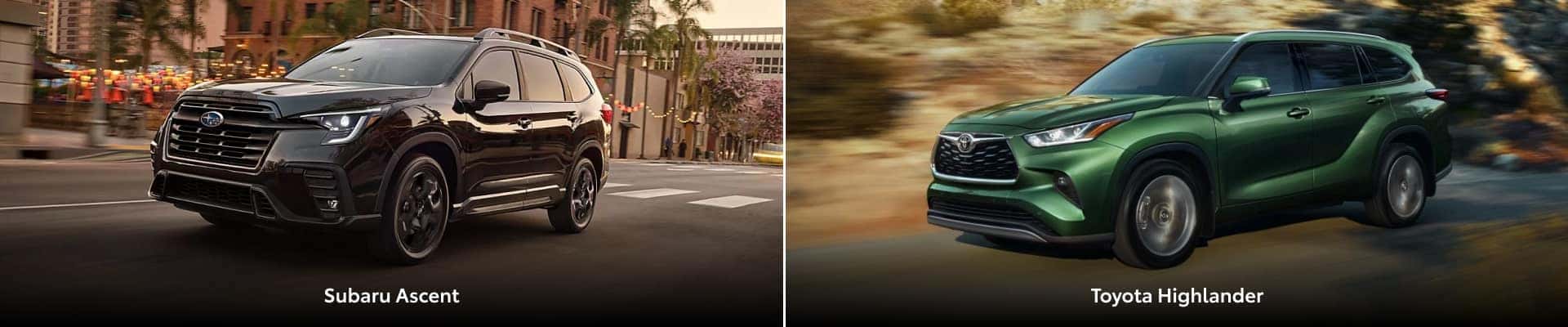
If your hunt for a midsize three-row SUV has led you to our Subaru Ascent vs. Toyota Highlander comparison, you're in for a treat. These two turbocharged SUVs have ample space for passengers in each of the three rows and reliable construction you can feel confident in as you drive. Although both are excellent, we feel there's a clear winner in the Subaru Ascent – a larger, more spacious, and more comfortable model. Schedule a time to explore the SUV that reigns supreme at Hughes Subaru today!
2025 Subaru Ascent:
2025 Toyota Highlander:
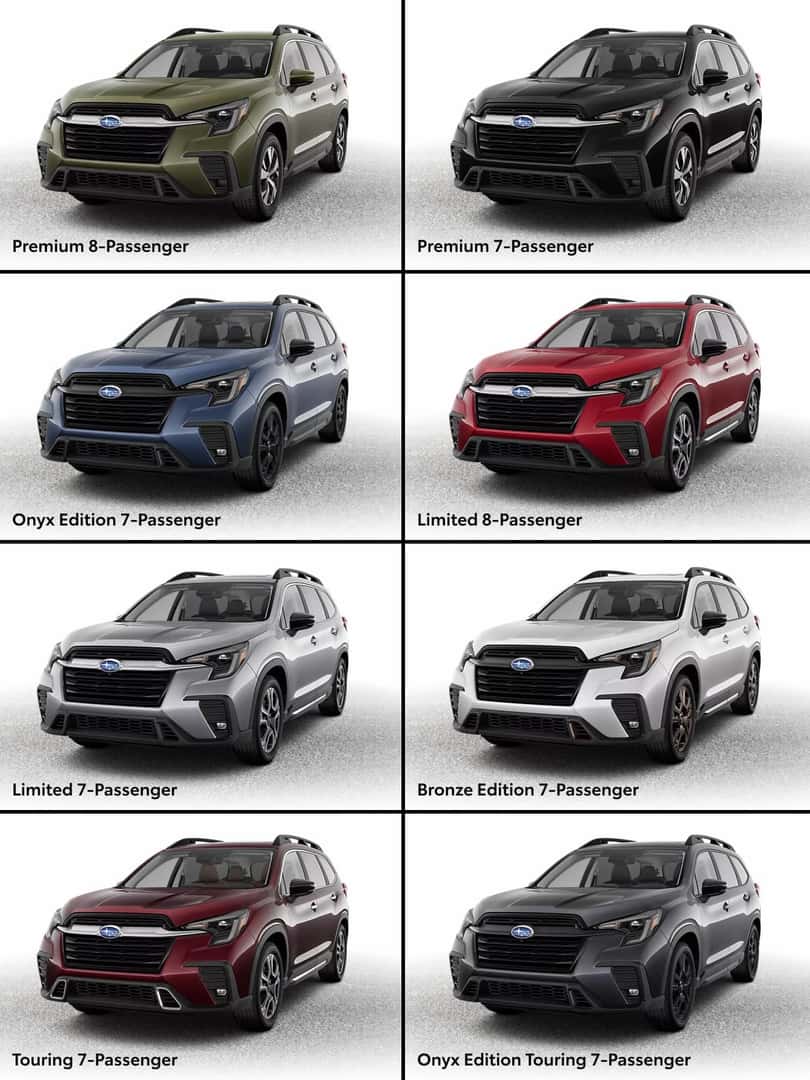
Let's kick off our Subaru vs. Toyota comparison with a look at the trims and features you can get for both models. Each model in our comparison is an excellent adventure vehicle with ample amenities, but which reigns supreme? For 2025, here are the available trim levels for the new Subaru Ascent for sale:
Within the lineup of Subaru Ascent trims, you'll find exceptional standard and available convenience and comfort features, with LED steering responsive headlights, Blind-Spot Detection with Lane Change Assist, heated front seats, ventilated front seats, a heated steering wheel, Nappa leather upholstery, and more.
The 2025 Toyota Highlander has a much smaller selection of trim levels:
The Toyota Highlander is a comprehensive three-row SUV with tons of features, like an available 12.3-inch touchscreen display, seating for up to eight passengers, and available safety and convenience enhancements. However, its higher asking price means that its standard selection, like its 8-inch touchscreen and six-speaker sound system, will leave a bit to be desired.
The two models in our 2025 Toyota Highlander vs. 2025 Subaru Ascent battle are similar in many regards, but their trim offerings are one area in which they differ – and the Ascent pulls ahead. The Highlander may have many appealing features and trims, but it lacks the variety of the 2025 Subaru Ascent.
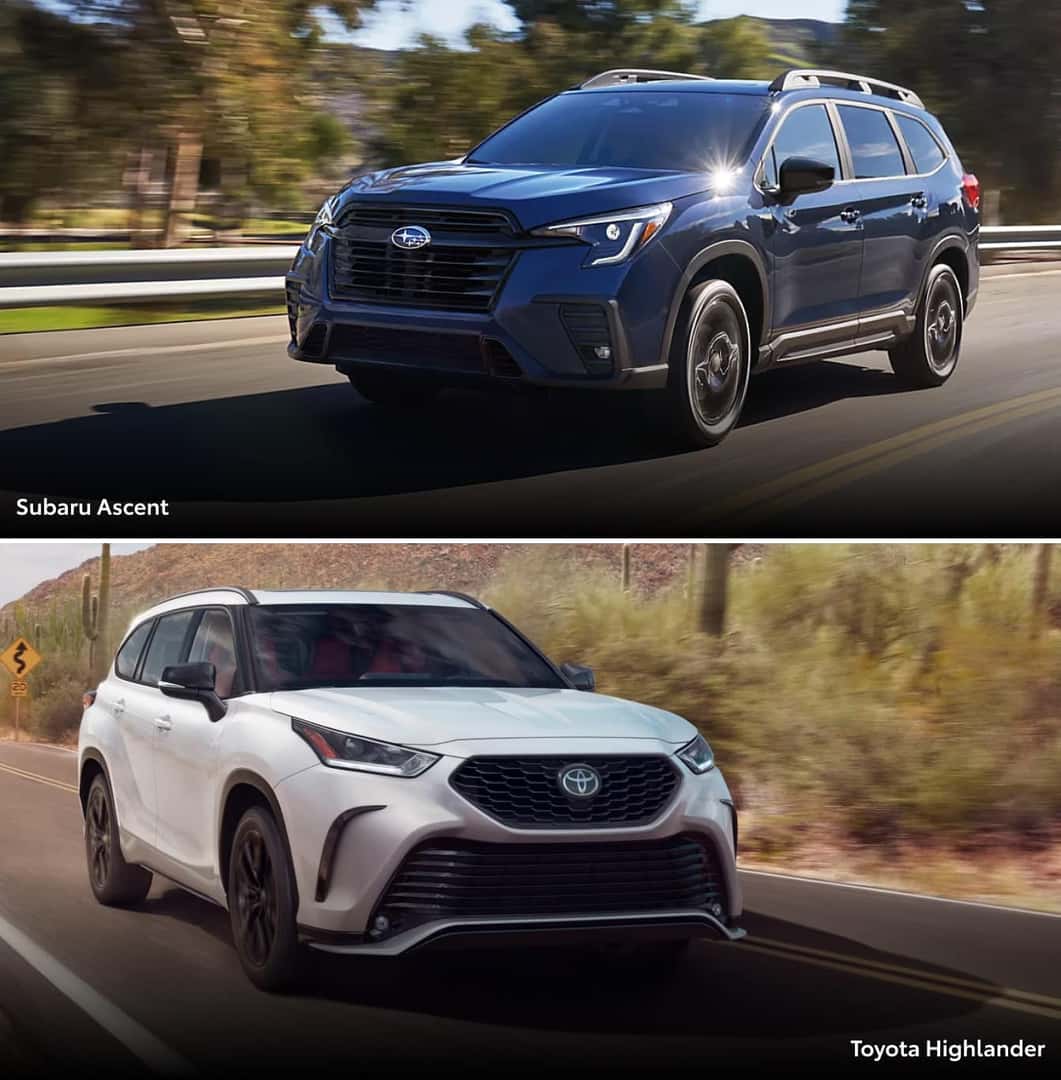
Now that we've explored the various trim level offerings and some of the perks of each model in our comparison, it's time to look at the impressive Subaru Ascent vs. Toyota Highlander specs. The two models have similar horsepower and torque performance specs, making a journey in either option as smooth and consistent as the other.
Each vehicle operates on a 2.4-liter turbocharged four-cylinder engine, with the Subaru Ascent producing 260 horsepower and 277 pound-feet of torque. The Highlander engine produces 265 horsepower and 310 pound-feet of torque.
Although both are appealing, the Subaru Ascent operates with standard Symmetrical All-Wheel Drive, which enhances handling and traction when traveling in more challenging conditions. In contrast, the Toyota Highlander operates on a standard FWD powertrain. We can keep your engine and powertrain as healthy as possible alongside our recommended Subaru Ascent maintenance schedule.
| 2025 Subaru Ascent | 2025 Toyota Highlander | |
| Engine | 2.4L turbo 4-cyl | 2.4L turbocharged 4-Cyl |
| Max Horsepower | 260 | 265 |
| Max Torque | 277 lb-ft | 310 lb-ft |
| Max Towing capacity | 5,000 lb3 | 5,000 lbs4 |
| Max EPA-Est. MPG (Cty / Hwy / Comb) for gas-powered engines | 20 / 26 / 225 | 22 / 29 / 256 |
| Transmission | Lineartronic CVT | 8-speed automatic |
| Drivetrain | Subaru Symmetrical All-Wheel Drive |
|
| Wheelbase | 113.8 in | 112.2 in |
| Ground clearance | 8.7 in | 8 in |
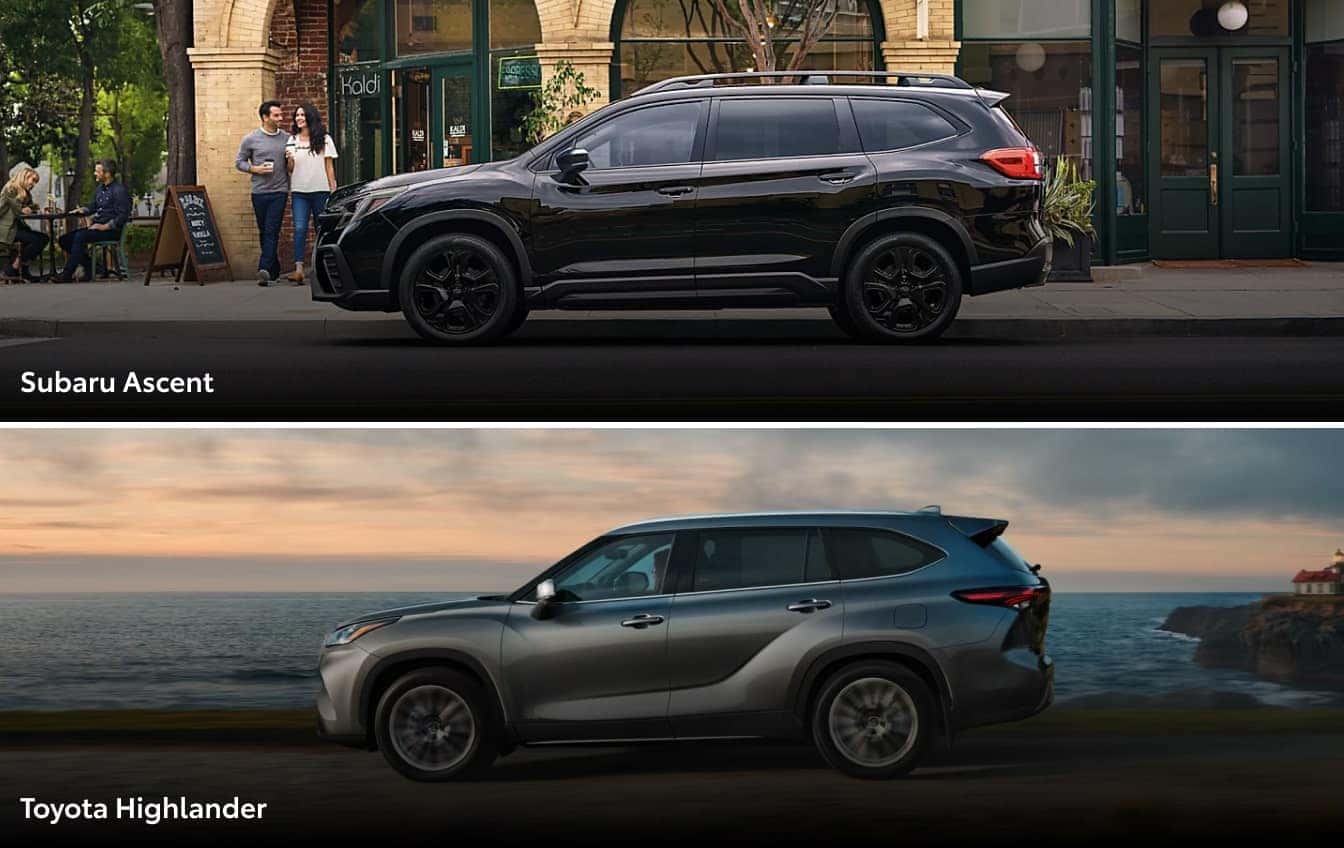
Thrilling performance meshes with compelling dimensions in both SUVs in our comparison, but we find the Subaru Ascent is a larger, more appealing size. The Ascent measures 196.8 inches in length, while the Highlander is only 194.9 inches long. The two are the same width, but the Subaru Ascent gives a taller ride height of 71.6 inches. The Toyota Highlander is only 68.1 inches tall.
As mentioned above, the Subaru Ascent is larger than the Toyota Highlander, which creates a more comfortable cabin for you and your family. The model has more passenger volume, with 153.2 cubic feet available, while the Highlander only offers 141.8 cubic feet.
The Subaru Ascent gives you more space in the trunk, making grocery trips with the whole family less cramped while offering competitive maximum cargo capacity as you fold the seats down. To highlight its dedication to passenger satisfaction, the Ascent has more shoulder room, more headroom, and more legroom than the Toyota Highlander in nearly every row.
| 2025 Subaru Ascent Premium 8-Passenger | 2025 Toyota Highlander LE | |
| Length | 196.8 in | 194.9 in |
| Width | 76.0 in | 76.0 in |
| Height | 71.6 in | 68.1 in |
| Seating Capacity | 8 | 8 |
| Cargo Space Behind Third Row | 17.8 cu ft | 16 cu ft |
| Cargo Space Behind Second Row | 43.5 cu ft | 48.4 cu ft |
| Max Cargo Space | 75.6 cu ft | 84.3 cu ft |
| Headroom (first / second / third row) | 41.2 in / 40.0 in / 36.2 in | 41.2 in / 39.4 in / 36.1 in |
| Legroom (first / second / third row) | 42.2 in / 38.6 in / 31.7 in | 42.0 in / 38.7 in / 28.0 in |
| Shoulder room (first / second / third row) | 61.1 in / 60.3 in / 57.0 in | 59.0 in / 58.7 in / 55.0 in |
| Hip room (first / second / third row) | 57.8 in / 57.2 in / 45.9 in | 57.2 in / 57.0 in / 45.6 in |
| Maximum Pasenger Volume | 153.2 cu ft | 141.8 cu ft |
So, which of the two vehicles in our Subaru Ascent vs. Toyota Highlander comparison takes the crown? Both are three-row SUVs with appealing dimensions and size, but the Subaru Ascent delivers more with standard AWD and enhanced handling, higher ground clearance, a longer and taller frame, and bigger interior dimensions.
We're ready to get you on the road in a model your family will fall in love with. When you lease a Subaru Ascent, you'll have an accessible suite of terms to choose from, letting you climb trim levels with a flexible contract. Depending on the terms, you can keep it for a few years, see how the Ascent improves your day-to-day, and then buy, return, or upgrade it!
Thinking about a different family-first model? Our new Subaru lease deals are the perfect gateway into experiencing the Subaru ownership experience before you commit to a purchase. If you're in the Atlanta, GA, area, stop by to get more details from our Hughes Subaru experts today!
Both models within our 2025 Toyota Highlander vs. 2025 Subaru Ascent comparison are highly regarded as safe options; however, the Ascent pulls slightly ahead in this category. For example, the NHTSA awards both models with a five-star rating, but the Subaru three-row SUV took home an extra five-star rating in frontal crash safety – a category that the Highlander only has four stars in.1
The Subaru Ascent is larger than most Highlander trims. Every trim for the 2025 Ascent measures 196.8 inches long, while the Toyota Highlander varies depending on the trim. Nearly every tier for the 2024 Highlander measures 194.9 inches long, but that measurement jumps to 197.4 inches with the XSE trim. The Ascent holds an edge in height, at 71.6 inches vs. 68.1 inches.
The two vehicles in today's comparison both have compelling towing capabilities. The Toyota Highlander and the Subaru Ascent boast the same towing capacity of 5,000 pounds across their non-hybrid trims.3, 4 This means you can haul small utility trailers, canoe or ATV carriers, and even select campers behind either three-row SUV. However, the Ascent offers more ground clearance, making it the premium option for adventures.
While the Toyota Highlander can boast more overall cargo space with the two rear rows down, the Subaru Ascent is the clear winner in cargo space in the trunk. With 17.8 cubic feet of space behind the third row, the Ascent adds 1.8 cubic feet to your capacity compared to the Highlander trunk. For day-to-day storage, the Ascent is the more convenient option.
The Toyota Highlander fuel economy ranges from an EPA-estimated 21/28/24 MPG (City/Highway/Combined)6 to an EPA-estimated 22/29/25 MPG (City/Highway/Combined.6 Meanwhile, the Subaru Ascent gets an EPA-estimated 20/26/22 MPG (City/Highway/Combined)5 on the first two trims and an EPA-estimated 19/25/21 MPG (City/Highway/Combined)5 on the rest.
1Reference to this third-party claim is solely for informational purposes and not to be relied upon. For details regarding this rating, visit www.nhtsa.gov
2Reference to this third-party claim is solely for informational purposes and not to be relied upon. For details regarding this award, visit www.iihs.org
3Maximum towing capacity varies by trim level. Trailer brakes may be needed. See your retailer for details.
4Before towing, confirm your vehicle and trailer are compatible, hooked up and loaded properly and that you have any necessary additional equipment. Do not exceed any Weight Ratings and follow all instructions in your Owner’s Manual. The maximum you can tow depends on base curb weight plus the total weight of any cargo, occupants, and added vehicle equipment. “Added vehicle equipment” includes additional standard/optional equipment and accessories added by the manufacturer, dealers, and/or vehicle owners. The only way to be certain of your vehicle’s exact curb weight is to weigh your vehicle without passengers or cargo. [Calculated with the new SAE J2807 method.] Installation of a tow hitch receiver or other accessories located near the rear bumper or side-door kick sensors may require disabling or removing the kick sensor, and the sensor operation setting in your vehicle should be turned off. See Owner’s Manual for limitations.
5EPA fuel economy estimates. Actual mileage will vary with driving conditions and your vehicle’s condition.
6Use for comparison purposes only. Your mileage will vary for many reasons, including your vehicle’s condition and how/where you drive. See www.fueleconomy.gov.